
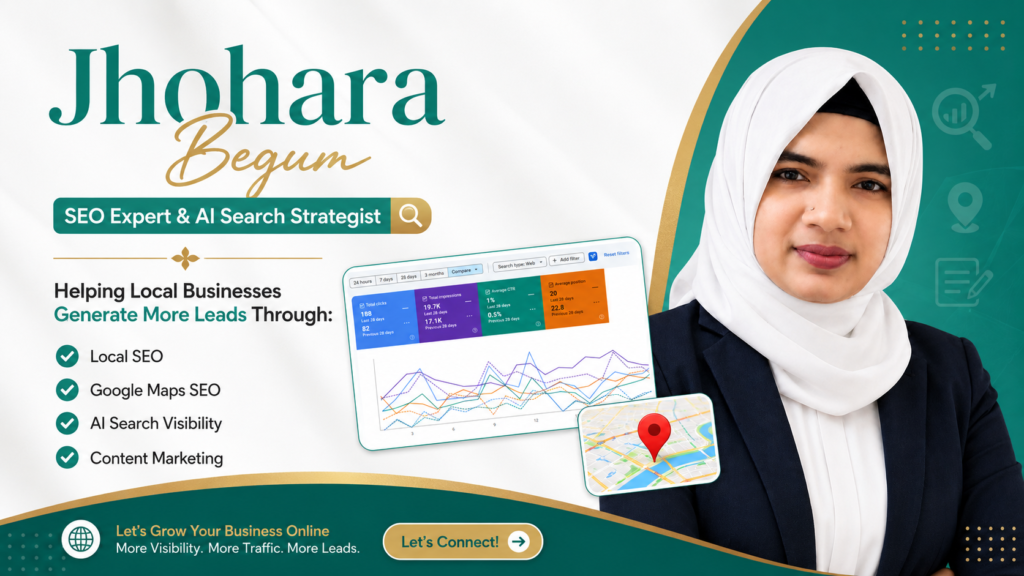
Fence Company SEO Case Study: 129% More Organic Clicks
I grew a fence services company’s online visibility by combining website SEO, local service content, Google Business Profile optimization and accurate performance tracking. In the latest 28-day comparison, organic clicks increased from 82 to 188, impressions rose from 17,100 to 19,700, CTR doubled from 0.5% to 1%, and average position improved from 22.8 to 20.
That represents approximately:
- 129% growth in organic clicks
- 15% growth in search impressions
- 100% improvement in average CTR
- A 2.8-position improvement in average ranking
My name is Jhohara Begum, and I am an SEO specialist from Bangladesh with more than three years of experience and over 10 completed SEO projects. I work with local businesses, service companies, e-commerce websites and international brands using white-hat SEO, local SEO, AEO, GEO and AI-focused content strategies.
Google Search Console defines clicks as visits from Google Search, impressions as the number of times a result appeared, CTR as clicks divided by impressions and average position as the average position of the highest result from the website.
These figures indicate that the website was:
- Appearing for more searches.
- Attracting more clicks from those searches.
- Improving its average search position.
- Becoming more relevant to qualified local searchers.
The Main SEO Challenges
Before optimization, the business had a common problem faced by many fence contractors: it offered valuable services, but Google did not have enough clear, structured and location-relevant information to connect those services with nearby customers.
The main weaknesses included:
- Weak service and location targeting
- Limited topical authority
- Inconsistent website and GBP signals
- Poor conversion measurement
My Local SEO Strategy for a Fence Company
I focused on a practical, results-driven SEO approach designed to improve visibility, traffic, and lead generation.
First, I conducted a full website and data audit, reviewing performance, indexing, rankings, page quality, site speed, mobile usability, and conversion paths. Instead of fixing everything, I prioritized issues that would have the biggest impact.
Next, I created a structured keyword map based on services and locations. This included:
- Core fence service keywords
- Local and city-based searches
- Service + location combinations
I then optimized key service pages to match user intent by adding:
- Clear headings and direct answers
- Local relevance and service details
- FAQs, trust signals, and strong CTAs
To support SEO further, I built helpful content focused on real customer questions, such as:
- Fence material comparisons
- Installation preparation tips
- Maintenance guides
I also optimized the Google Business Profile by improving categories, services, photos, and engagement with reviews—without using spam tactics.
Additionally, I strengthened internal linking to connect related pages and guide users naturally.
Finally, I improved conversions by ensuring:
- Easy contact options
- Fast-loading pages
- Clear calls to action
This strategy helped turn traffic into real leads.
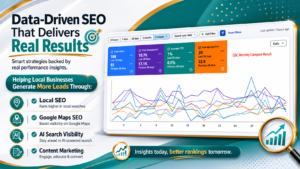
Google Search Console: 28-Day Comparison
The comparison screenshot shows 188 clicks, 19.7K impressions, a 1% CTR and an average position of 20 in the latest 28 days. The previous period produced 82 clicks, 17.1K impressions, a 0.5% CTR and an average position of 22.8.
The most important result is not simply the increase in impressions. Clicks increased much faster than impressions, which indicates stronger search-result performance and more relevant visibility.
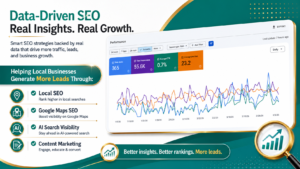
Three-Month Organic Search Performance
Across the three-month Search Console view, the website generated:
- 365 organic clicks
- 55.6K search impressions
- 0.7% average CTR
- 23.2 average position
This shows that the business was building broader organic visibility, but it also identifies the next opportunity: improving CTR and moving high-impression keywords from pages two and three toward the first page.
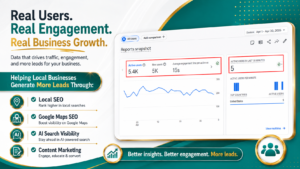
Google Analytics Website Traffic
For April 1–30, 2026, the Google Analytics snapshot shows:
- 5.4K active users
- 5K new users
- 15 seconds average engagement time per active user
- Five real-time users from the United States at the moment of capture
This screenshot should be interpreted carefully. GA4 active users can include organic, direct, referral, paid and other traffic sources, so these numbers should not be presented as organic search traffic unless the report is filtered by channel.
The 15-second average engagement time also shows that traffic growth was not the end of the work. Improving page intent, speed, mobile usability, content relevance and calls to action became an important next-stage priority.
What Worked Best
Stronger search-intent alignment
The biggest improvement came from connecting each page to a specific customer need. A visitor searching for privacy fencing should reach a page focused on privacy fencing—not a generic homepage covering every service.
Better titles and search snippets
Pages receiving impressions but few clicks were reviewed for:
- Weak titles
- Missing service terms
- Missing location relevance
- Unclear benefits
- Titles that did not match search intent
Website and GBP coordination
GBP posts linked to relevant articles and service pages rather than sending every visitor to the homepage. This helped create a clearer journey from local discovery to service evaluation.
Consistent measurement
The project used Search Console and GA4 for different purposes:
- Search Console measured Google Search visibility.
- GA4 measured website users and engagement.
- UTM links separated GBP post visits from general organic traffic.
- Conversion events were needed to measure calls, forms and estimates.
Common Fence Company SEO Mistakes
Creating thin city pages
Changing only the city name across dozens of nearly identical pages creates little value. Every location page should include meaningful service-area information, relevant projects, FAQs, customer concerns and original content.
Stuffing the GBP business name
Adding phrases such as “Best Fence Company Seattle Privacy Fence Experts” is not a sustainable strategy unless that wording is the real-world business name.
Targeting “near me” without local eligibility
Keywords such as best SEO company near Seattle or web design company near me do not make a company physically local. Near-me visibility depends heavily on the searcher’s location and the business’s legitimate location or service area.
Reporting impressions as leads
An impression is not a website visit, and a website visit is not automatically a lead. Professional reporting should separate:
- Visibility
- Traffic
- Engagement
- Enquiries
- Qualified leads
- Sales
Ignoring low engagement
More users are not always better users. If engagement is weak, the landing page may be slow, confusing or mismatched with the query.
Keyword Strategy for Seattle and Fence Company SEO
The strongest keywords for this case study are:
- Local SEO for fence companies
- GBP SEO for fence companies
- Fence company local SEO experts
The following terms can support a Seattle-focused service page when the business genuinely serves customers in that market:
- Seattle local SEO services
- SEO help for small business Seattle
- Best SEO experts Seattle Washington
- Best SEO company near Seattle
However, these phrases should not be forced into every paragraph. A business without a genuine Seattle location should not suggest that it has a local office there. A more accurate phrase for a remote provider would be:
Remote SEO consultant providing local SEO support for Seattle small businesses.
This protects trust while still communicating the market being served.
How Much Does Fence Company SEO Cost?
I do not disclose the client’s exact project fee because pricing and contract details are private.
The cost of a fence company SEO campaign depends on:
- Number of service areas
- Size and condition of the website
- Level of competition
- Number of service and location pages
- GBP condition
- Content requirements
- Link and citation work
- Conversion tracking
- Reporting frequency
My publicly listed SEO plans currently include:
- Starter SEO: $150–$300 per month
- Medium SEO: $300–$500 per month
- Premium SEO: $500+ per month
The correct plan depends on the website, competition and project goals.
A small contractor with one service area may need a focused campaign, while a multi-location company may require technical SEO, location content, GBP management and ongoing authority building.