
Plumbing Website SEO Case Study: 715% More Organic Clicks and 153 GBP Calls in Phoenix, Arizona
Local SEO growth is rarely the result of one dramatic change.
More often, meaningful progress comes from making a local business easier for Google to understand and easier for the right customer to find.
That was the focus of this plumbing website SEO project in Phoenix, Arizona.
The campaign was not built around chasing traffic for its own sake. A plumber does not benefit much from attracting thousands of visitors who live outside the service area or have no immediate need for plumbing work.
The priority was more practical:
Improve visibility for relevant local searches and connect the business with people already looking for plumbing solutions.
The performance data gives a useful picture of that progress.
SEO Results at a Glance
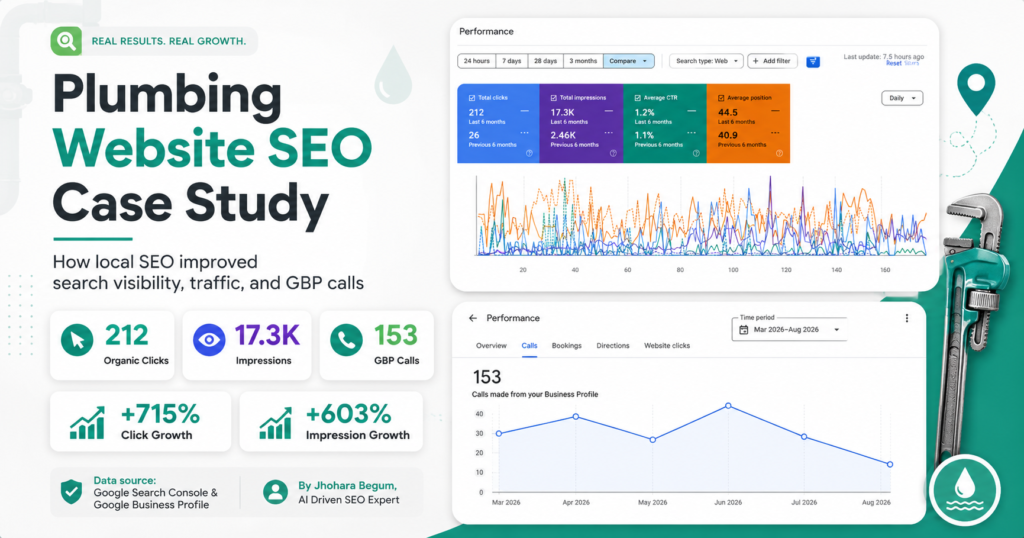
Google Search Console compared the most recent six-month period with the previous six months:
| Performance Metric | Previous 6 Months | Recent 6 Months |
|---|---|---|
| Total Organic Clicks | 26 | 212 |
| Total Impressions | 2.46K | 17.3K |
| Average CTR | 1.1% | 1.2% |
| Average Position | 40.9 | 44.5 |
Google Business Profile also recorded:
153 calls from March through August 2026.
The click increase is particularly important. The site moved from only 26 organic clicks to 212 clicks, while search visibility expanded from approximately 2,460 impressions to 17,300 impressions.
CTR also improved modestly from 1.1% to 1.2%.
There is another number worth discussing openly.
Average position moved from 40.9 to 44.5.
That means the aggregate average ranking did not improve during the comparison period.
I would not hide that in a professional SEO case study.
When a website begins appearing for many more search queries, Google Search Console can start counting new keywords where the site initially ranks deeper in the results. That wider keyword footprint can pull the overall average position downward even while total impressions and clicks increase substantially.
For this campaign, the combination of 17.3K impressions, 212 clicks and 153 Business Profile calls provides a much more useful view than looking at average position alone.
The Initial SEO Problem
The plumbing business had services people genuinely needed.
The challenge was connecting those services with the way local customers search.
A homeowner may not search for a company name.
They search for the problem in front of them:
- clogged drain service
- drain cleaner near me
- emergency plumber
- sewer repair
- water heater repair
- plumbing company in Phoenix
- local plumber near me
These searches have different levels of intent.
Someone reading about the causes of a slow drain is different from someone searching for a plumber because water is backing up into their home.
The SEO strategy therefore needed to identify and support high-intent customers for plumbers in the local area.
Why This Problem Is Common With Local Plumbing Companies
Many local companies have websites that technically work but are not structured around search behavior.
A plumbing company might provide drain cleaning, sewer repair, emergency plumbing, leak repair and water heater services.
But its website may describe all of those services on one generic page.
Google then has less context about which page should appear for a specific query.
This problem is common not only in plumbing but throughout SEO for home & garden businesses, including HVAC companies, roofers, electricians, landscapers and contractors.
There are usually three areas holding organic growth back.
1. Service Pages Are Too Broad
A customer searching specifically for drain cleaning should not have to interpret a general plumbing page.
The page itself should clearly explain the service.
That became an important part of the SEO for drain cleaners strategy.
Instead of forcing multiple unrelated keywords onto one page, each high-value service needed a clear search purpose.
A strong drain cleaning page, for example, should help Google and customers understand:
What problems the service solves.
What symptoms customers might notice.
When professional drain cleaning may be required.
What geographic area the company serves.
How the service relates to other plumbing problems.
This creates stronger relevance without keyword stuffing.
Insight 1: Build SEO Around Service Intent
The first practical lesson from this campaign is that local SEO becomes stronger when every important page has a clear job.
Rather than treating “plumbing” as one keyword, the website can develop individual topical relationships around services such as:
Drain Cleaning → Sewer Repair → Emergency Plumbing → Water Heater Services → Leak Repair
This supports both organic rankings and lead quality.
Someone searching for drain cleaning should land on information focused on drain cleaning.
Someone with a sewer problem needs different information.
That clarity also improves internal linking.
A drain cleaning page can naturally reference sewer inspection or sewer repair when discussing recurring backups.
The relationship between those pages helps Google understand the wider plumbing expertise of the business.
Completing the Plumbing Website SEO Audit
A professional plumbing website SEO audit service should go much further than checking whether keywords appear in titles.
For this campaign, on-page SEO work focused on areas that directly influence understanding, relevance and usability.
Page Titles and Meta Descriptions
Important service pages needed unique titles instead of repeating the same generic plumbing phrase.
Meta descriptions were written to accurately explain each page and encourage relevant searchers to click.
H1, H2 and H3 Structure
Each page needed one clear primary topic supported by logical subtopics.
Headings were structured for readability rather than being used as places to insert as many keywords as possible.
Internal Links
Related services were connected contextually.
This distributes internal authority and helps both users and search engines discover deeper pages.
Search-Friendly URLs
Clear URLs make page topics easier to understand.
For example:
/drain-cleaning-phoenix-az/
is more descriptive than an unclear or parameter-heavy URL.
Image SEO
Relevant images were supported with descriptive filenames and appropriate alternative text.
Alt text was written for accessibility and context rather than keyword repetition.
Content Quality
Thin pages were expanded where additional information genuinely helped customers understand the service.
The objective was not to hit an arbitrary word count.
The objective was to answer the questions that matter before someone contacts a plumber.
Insight 2: Local Relevance Is More Than Adding “Phoenix” to a Page
The second lesson involves geographic relevance.
For Phoenix local search optimization, placing “Phoenix” into every paragraph does not create strong local SEO.
Google needs multiple consistent signals showing the relationship between:
Business + Service + Location + Reputation
The website therefore needed to communicate actual service coverage clearly.
That same principle applies when businesses want visibility in surrounding Arizona markets.
For example, companies researching SEO services near me in Surprise, AZ or a local SEO service in Glendale, AZ still need strategies built around genuine geographic relevance rather than duplicated city pages.
Strong organic local SEO growth in Arizona depends on creating pages that have a legitimate reason to exist.
A location page should provide useful information for people in that market.
Changing only the city name from Phoenix to Glendale or Surprise is not enough.
Insight 3: SEO Performance Should Be Connected to Lead Intent
The third lesson is perhaps the most important.
SEO should not be judged only by rankings.
This campaign demonstrates why.
The Google Search Console average position moved from 40.9 to 44.5, yet organic clicks climbed from 26 to 212, impressions reached 17.3K, and the Google Business Profile generated 153 calls between March and August 2026.
Those metrics tell a more complete story.
The GBP calls are particularly valuable as a commercial-intent indicator.
They should not automatically be described as 153 completed jobs or confirmed customers. A call is not the same as a booked service.
But it does show that people were taking a meaningful step toward contacting the business.
That is where plumbing lead generation service strategy and SEO begin to overlap.
Local search visibility has greater business value when users can easily move from discovery to contact.
Plumber Reputation Management Supported the Local Strategy
Local plumbing is a trust-based service.
Customers may be allowing someone into their home while dealing with an urgent and expensive problem.
Reputation therefore matters before the phone ever rings.
Plumber reputation management supports SEO by strengthening the overall credibility of the business across the local search ecosystem.
Reviews, consistent business information, local mentions, website trust signals and Google Business Profile activity all help users evaluate whether the company appears legitimate and dependable.
A website cannot operate as an isolated SEO asset.
For a local business, the website and Business Profile should reinforce the same business entity.
Building Authority With Relevant Links
Another part of the campaign involved thinking about authority more strategically.
Effective plumber website SEO link building services should not be judged by the number of backlinks acquired.
Relevance matters.
A contextual reference from a credible local or industry-related source can make much more sense than dozens of unrelated links created only for SEO.
This is especially important for businesses looking for effective organic SEO growth in Phoenix, AZ.
Shortcuts may temporarily create numbers in a backlink report without strengthening the real authority of the business.
Sustainable authority develops through relevant references, business relationships, useful content and legitimate industry or local connections.
What the Performance Data Actually Tells Us
The most striking change was search visibility.
Moving from 2.46K to 17.3K impressions indicates that Google began showing the website across a substantially larger search footprint.
Clicks increased at the same time from 26 to 212.
CTR improved slightly from 1.1% to 1.2%.
Meanwhile, Google Business Profile produced 153 calls during the March-August 2026 period.
Rather than describing this simply as “ranking growth,” I would describe it as search visibility and customer-discovery growth.
That distinction matters.
The average ranking figure tells us there is still room for further optimization.
Many newly discovered terms may still be sitting beyond the first page.
Those existing impressions represent future opportunity.
Improving pages already receiving impressions but ranking outside strong click positions can potentially create additional growth without having to start from zero.
Affordable Organic SEO Growth Should Still Be Strategic
Businesses frequently look for affordable organic growth of SEO in Phoenix, Arizona.
Others search for terms such as cheap organic growth of SEO in Phoenix, AZ.
The intent behind these searches is understandable.
Local businesses have limited budgets and need to know whether SEO will support commercial growth.
But affordable and cheap are not necessarily the same strategy.
Effective affordable organic SEO growth in AZ comes from prioritization.
Fix the pages closest to customer intent.
Strengthen important service relationships.
Clarify geographic relevance.
Improve search snippets.
Build reputation.
Develop credible authority.
Those actions can produce more sustainable value than spreading the same budget across dozens of low-impact activities.
Key Lessons From This Phoenix Plumbing Website SEO Campaign
The performance data reinforced three principles.
First, optimize around the problem the customer is trying to solve.
Service-specific search intent creates stronger relevance than a website trying to rank one generic plumbing page for everything.
Second, build real local context.
Phoenix local search optimization depends on more than geographic keyword repetition.
Third, measure the customer journey, not one SEO metric in isolation.
An average ranking can move in the wrong direction while impressions, clicks and customer actions improve.
A credible SEO analysis needs to explain both sides.
Final Perspective
The strongest result from this plumbing SEO project was not one keyword reaching one particular position.
It was the change in how often the business could be discovered.
Google Search visibility expanded from 2.46K to 17.3K impressions.
Organic clicks increased from 26 to 212.
Google Business Profile recorded 153 calls from March through August 2026.
At the same time, average position moved from 40.9 to 44.5, showing that there is still meaningful work available in turning wider keyword visibility into stronger first-page positions.
That combination makes the case study more useful.
SEO is rarely a straight line where every metric improves simultaneously.
Sometimes growth begins by expanding how many relevant searches a business appears for. The next challenge is moving more of those impressions upward and converting more of that visibility into qualified customer actions.
For local companies, that may be a better definition of successful SEO organic growth in Phoenix:
not simply appearing for more keywords, but gradually becoming easier to find when the right local customer is already looking for the service you provide.